
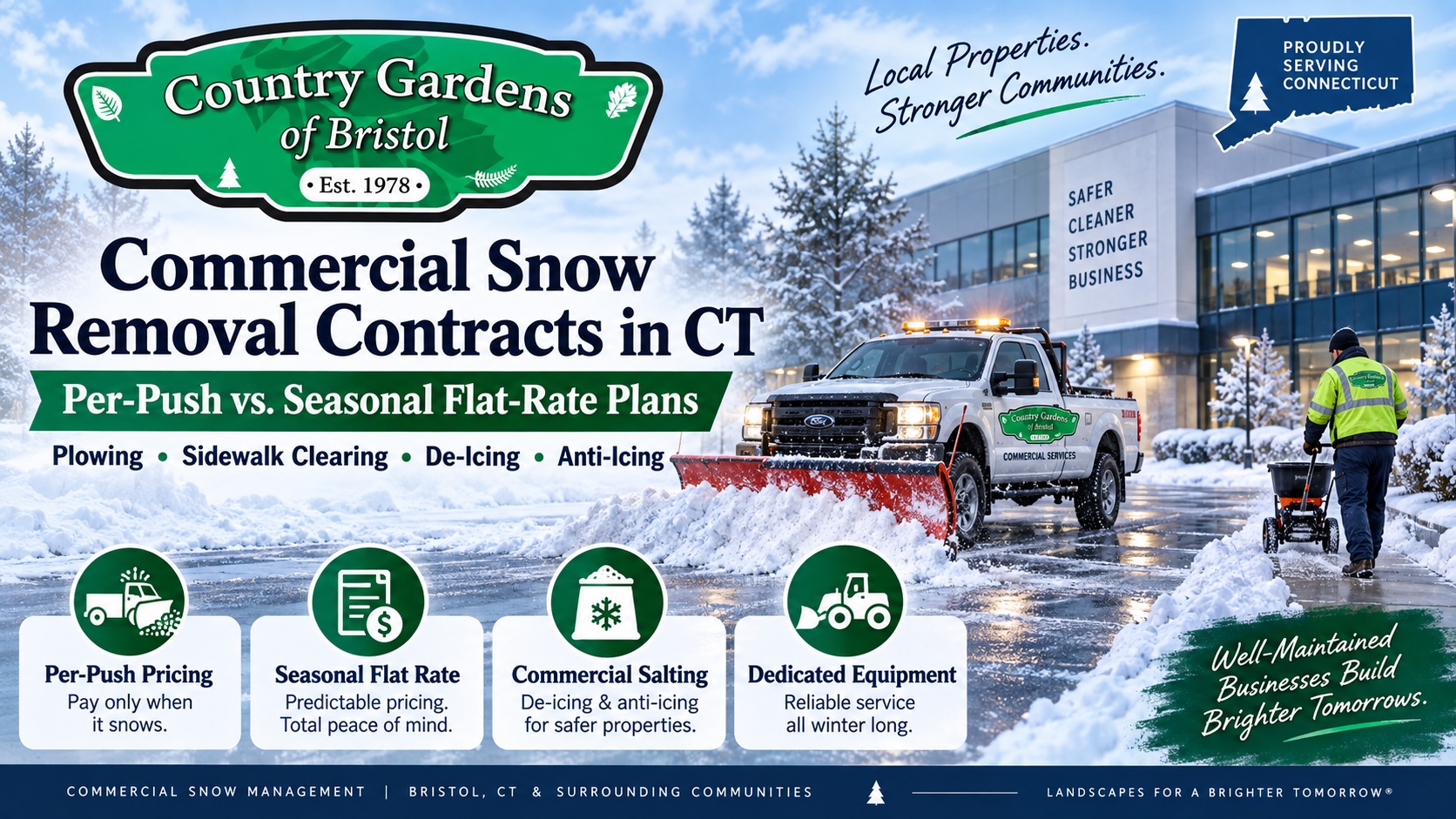
For Connecticut businesses, the best commercial snow contract depends on property size, snow tolerance, operating hours, budget predictability, and the level of service required. Per-push contracts charge each time crews plow or service the property, while seasonal flat-rate contracts establish a predetermined winter price for an agreed scope. At Country Gardens of Bristol, we recommend evaluating trigger depth, parking lot clearing, sidewalk service, de-icing, refreeze checks, snow hauling, response windows, and storm documentation before comparing price alone. Our commercial program includes parking lot clearing, sidewalks and entrances, de-icing, liquid anti-icing, emergency response, custom service-level agreements, and predetermined snow-stacking areas.
Per-Push Commercial Snow Plowing Pricing
A per-push snow contract bills according to each service event.
A commercial agreement may define pricing by:
- Plow visit
- Snowfall depth
- Sidewalk service
- Salt application
- Liquid anti-icing treatment
- Loader work
- Snow hauling
- Return visits for refreeze
A common structure separates accumulation into ranges such as:
1 to 3 inches: Base plowing rate
3 to 6 inches: Higher event rate
6 to 9 inches: Additional equipment or service rate
Major storms: Hourly, storm-specific, or predetermined extended-event pricing
Exact ranges and rates should be written into the agreement.
When Per-Push Works Best
We often see per-event billing work well for:
- Smaller commercial properties
- Businesses with flexible operating hours
- Properties that can tolerate occasional service-cost variation
- Winters with relatively low snowfall
- Facility managers wanting to pay based on actual events
The tradeoff is budget uncertainty.
A light winter can reduce total snow spending. A season full of repeated storms, overnight refreezing, and ice events can push costs much higher.
Seasonal Flat-Rate Snow Contracts
A seasonal agreement establishes a fixed or largely predictable price for the winter season based on a defined scope.
This can include:
- Parking lot plowing
- Sidewalk clearing
- Entrance clearing
- De-icing
- Storm monitoring
- Equipment allocation
- Post-storm inspection
- Refreeze response
Seasonal contracts make winter budgeting easier because facility managers know the expected cost before snow begins.
They can be especially useful for:
- Retail centers
- Office buildings
- Industrial properties
- Medical facilities
- HOAs
- High-traffic commercial sites
- Properties where dependable access is essential
However, not every “flat-rate” agreement is unlimited. Contracts may contain snowfall caps, extraordinary-storm clauses, snow-hauling exclusions, or separate charges for ice events.
That is why the written scope matters.
Per-Push vs. Seasonal Snow Contracts
| Contract Factor | Per-Push | Seasonal Flat Rate |
|---|---|---|
| Budget predictability | Lower | Higher |
| Light winter cost | Potentially lower | Usually unchanged |
| Heavy winter exposure | Higher | More controlled |
| Billing | Per event/service | Predetermined seasonal price |
| Best fit | Smaller or flexible sites | High-priority commercial properties |
| Snowfall triggers | Essential | Essential |
| Salt and sidewalks | May be separate | May be bundled or separate |
| Snow hauling | Usually separate | Contract dependent |
Neither model is automatically cheaper.
The best contract is the one that clearly matches the property’s operational requirements.
What Should Snow Removal Contract Templates Include?
Facility managers searching for snow removal contract templates should focus less on generic wording and more on measurable service standards.
We recommend documenting:
Trigger Depth
The agreement should state exactly when automatic dispatch begins.
Country Gardens offers custom Service Level Agreements based on property needs, budget, and specific trigger-depth requirements.
Priority Areas
Define which areas must be cleared first, such as:
- Emergency lanes
- Main entrances
- Loading docks
- Employee entrances
- ADA access routes
- High-traffic sidewalks
Service Timing
A property opening at 6:00 AM requires a different operational plan than an office opening at 9:00 AM.
Define target completion windows and expectations during continuous snowfall.
De-Icing
The agreement should state whether salt, treated materials, or liquid anti-icing are included and when applications occur.
Snow Storage
Snow piles should be planned before winter.
Country Gardens identifies stacking areas during pre-season walkthroughs so snow does not unnecessarily obstruct sightlines, hydrants, or valuable parking spaces. Snow hauling can be arranged when on-site storage becomes limited.
Pre-Storm Liquid Anti-Icing Can Change the Entire Service
Commercial snow management should begin before the first plow pass.
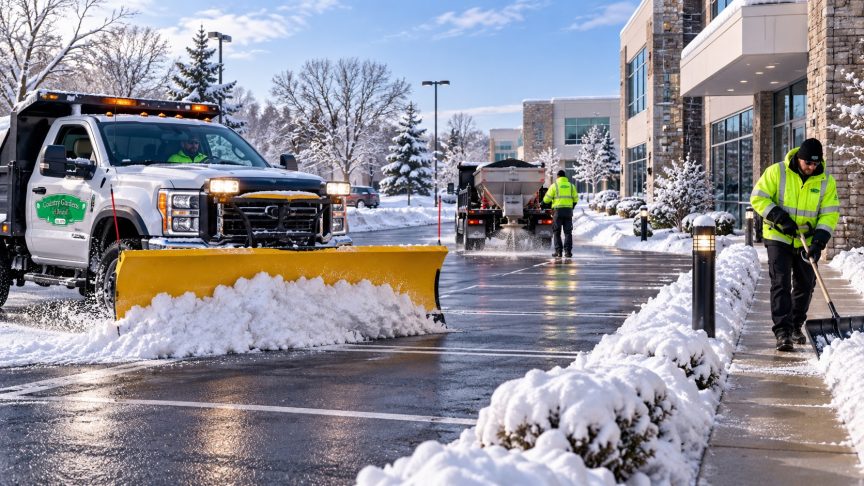
Liquid anti-icing treatment can be applied before qualifying storms to reduce the bond between frozen precipitation and pavement.
That can make subsequent mechanical clearing more effective and help reduce hard-packed snow or underlying ice.
Country Gardens uses liquid anti-icing agents and calibrated salt application as part of its commercial snow and ice management approach.
For businesses searching for a commercial salting service near me, we recommend asking whether the contractor offers both pre-storm and post-storm ice management.
Sidewalk Clearing Needs Its Own Plan
Parking lots receive most of the attention, but entrances and sidewalks may create just as much operational risk.
Commercial contracts should define:
- Who clears sidewalks
- Which entrances are included
- How often sidewalks are checked
- When deicer is applied
- Who handles overnight refreeze
- Whether loading docks and emergency exits are included
Country Gardens uses dedicated sidewalk and entrance crews alongside commercial parking lot operations.
Connecticut law also allows municipalities under certain circumstances to place snow and ice responsibilities for abutting public sidewalks on property owners or those in control of the property. Contract language should therefore accurately define each party’s responsibility rather than promising “zero liability.”
Connecticut snow and ice contract requirements
Dedicated Equipment Staging Reduces Storm Delays
Large commercial sites may need plow trucks, loaders, pushers, sidewalk equipment, spreaders, and backup machinery available before the storm starts.
Staging equipment close to priority properties can reduce travel delays when roads become difficult.
For major commercial accounts, we plan around:
property size + equipment requirements + opening time + snow-storage capacity + service priority
The goal is to avoid improvising once accumulation has already begun.
Plan the Contract Before the First Connecticut Storm
At Country Gardens of Bristol, our commercial snow removal services support retail centers, offices, industrial sites, HOAs, and other commercial properties with plowing, sidewalk clearing, de-icing, emergency response, snow management, and custom contracts.
The best time to compare commercial snow plowing pricing is before the first forecast calls for accumulating snow.
A detailed contract gives both the property manager and snow contractor a clear operating plan for trigger depths, equipment, sidewalks, salt, parking lots, refreeze, and storm response.