
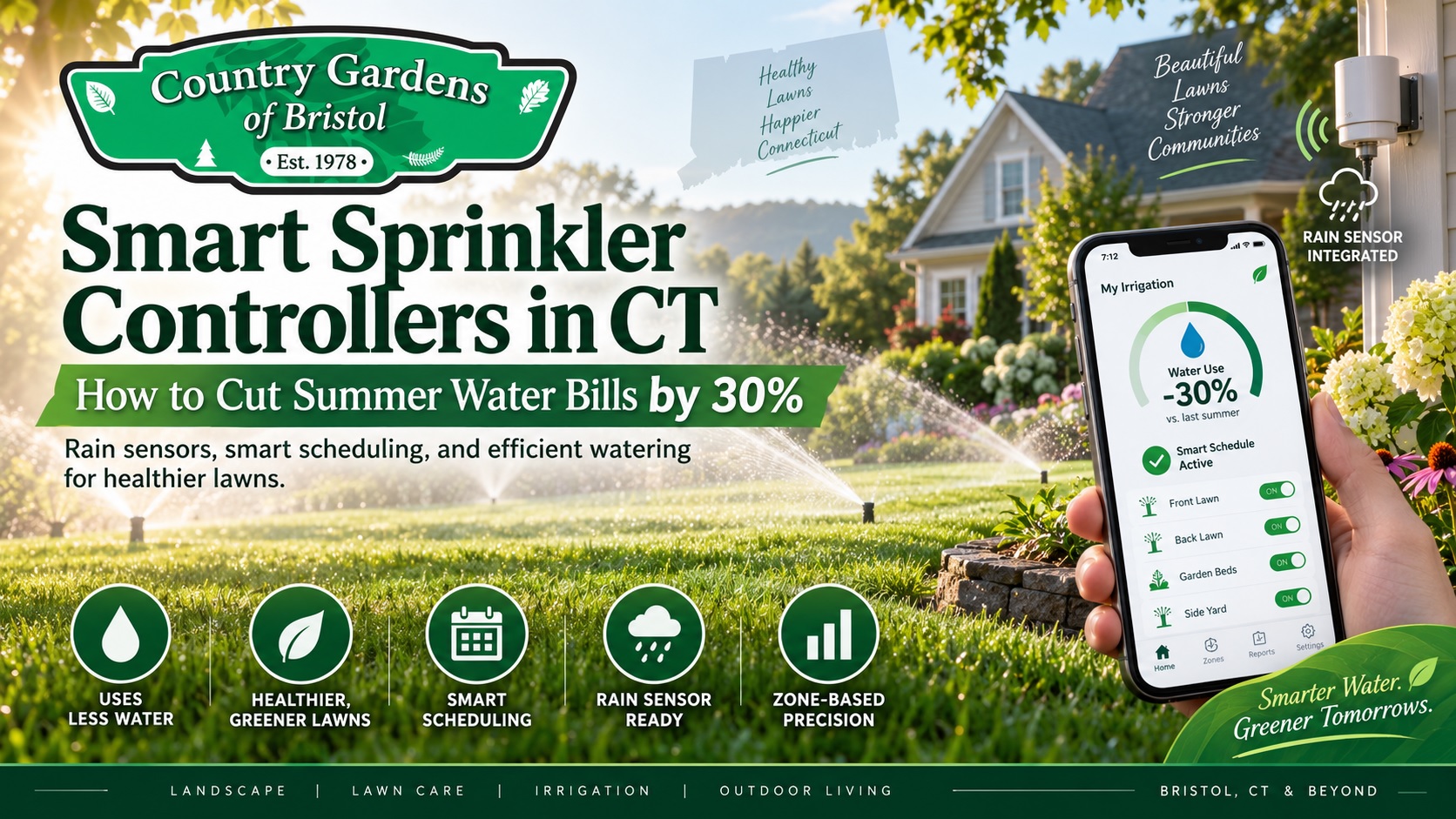
Can a Smart Sprinkler Controller Lower Water Bills?
Yes. A properly programmed smart irrigation controller with WiFi, rain-sensor integration, calibrated sprinkler heads, and correctly designed watering zones can significantly reduce unnecessary irrigation during Connecticut summers. EPA studies of weather-based controllers have reported overall water savings ranging from about 6% to 30%, while WaterSense estimates an average home can save thousands of gallons annually by replacing a basic clock controller. Actual savings depend on the existing system, watering habits, soil, weather, and landscape design.
At Country Gardens of Bristol, we combine smart controls with zone calibration, rain sensors, seasonal adjustments, startup service, and fall winterization. A controller cannot save water if broken heads, poor coverage, or incorrect runtimes are wasting it first.
Why Traditional Sprinkler Timers Waste Water
Older irrigation controllers typically operate according to a fixed schedule.
If the controller says water for 25 minutes on Tuesday, the sprinklers may run even when:
- Heavy rain fell Monday night
- Temperatures dropped
- A shaded zone remains wet
- Clay soil cannot absorb water quickly enough
- A sprinkler head is spraying pavement
- Plants need less water than the lawn
EPA notes that conventional clock-based systems are often programmed around peak-season demand and are not adjusted as weather or plant needs change.
Smart controllers solve much of that problem by changing irrigation schedules automatically.
How Smart Irrigation Controllers Work
A modern controller can use local weather data, rainfall, temperature, seasonal conditions, soil information, and programmed landscape characteristics to determine how much watering is actually necessary.
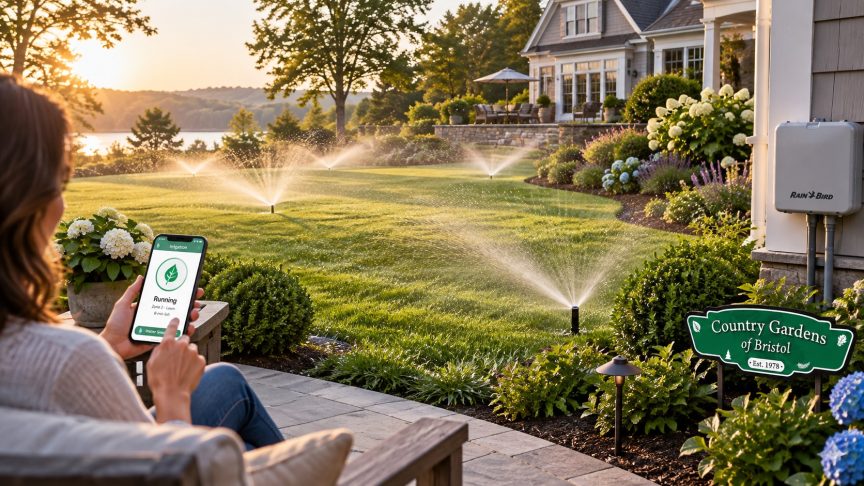
Many systems also offer smartphone access, giving homeowners control over individual zones without standing beside the controller.
Our irrigation services in Bristol, CT include system design, smart controller integration, rain sensors, seasonal startup, repairs, adjustments, and winterization. Country Gardens also installs contractor-grade systems using products from manufacturers such as Hunter and Rain Bird.
Rain Sensors Stop Irrigation When Nature Already Did the Job
One of the simplest upgrades is a functioning rain sensor.
Without one, an automatic system may water during or immediately after a storm.
WaterSense weather-based controllers are designed to work with rainfall devices and adjust irrigation according to changing conditions.
For Connecticut properties, that matters because summer weather can swing quickly from dry stretches to thunderstorms.
Instead of following one rigid weekly schedule, we want irrigation to respond to what the property actually receives.
Connecticut Clay Soil Needs Different Programming
Many local lawns contain soils with significant clay content.
Clay can retain moisture well, but it also absorbs water more slowly than sandy soil. Running a sprinkler zone continuously for too long may cause runoff before the water penetrates deeply.
For those areas, we may use cycle-and-soak scheduling.
Instead of watering a zone for 30 continuous minutes, the controller might divide that runtime into several shorter cycles with soaking periods between them.
That gives the soil more time to absorb water and can reduce:
- Runoff
- Puddling
- Water flowing onto pavement
- Shallow rooting
- Wasted irrigation
Smart technology works best when controller programming matches the soil rather than relying on factory-default settings.
Sprinkler Head Calibration Matters Just as Much
A smart controller cannot compensate for poor sprinkler coverage.
During a spring irrigation startup in CT, we inspect the system before peak summer demand arrives.
That may include checking:
- Sprinkler head alignment
- Broken or clogged nozzles
- Overspray onto driveways and sidewalks
- Low-pressure zones
- Leaks
- Rotors that no longer turn correctly
- Head-to-head coverage
- Controller programming
- Rain-sensor operation
Country Gardens provides seasonal startup, inspection, repairs, smart controller setup, and winterization as part of its irrigation services.
Even a small adjustment can keep hundreds of gallons from being sprayed where plants cannot use it.
How Much Can a Smart Controller Actually Save?
The often-cited 30% figure should be treated as a potential result, not a guarantee.
EPA reviewed studies showing weather-based controller savings ranging from approximately 6% to 30%, with an estimated typical reduction closer to 15%. EPA also reports that replacing a standard controller with a WaterSense-labeled weather-based model can save an average household about 7,600 gallons annually.
Properties that currently overwater have the greatest opportunity to save.
Homes already using conservative irrigation schedules may see smaller reductions.
What Does Sprinkler System Installation Cost in CT?
Sprinkler system installation cost in CT depends on property size, number of zones, water pressure, landscape complexity, controller choice, and installation conditions.
Country Gardens currently notes that a standard residential system in the Bristol area may commonly fall around $3,500 to $6,000+, depending on system complexity.
A professional estimate should account for more than the number of sprinkler heads. Hydraulic design, zoning, trenching, controls, backflow protection, and long-term service all affect system performance.
Do Not Forget Fall Winterization
Smart controls improve summer efficiency, but Connecticut irrigation systems still need fall protection.
Water remaining inside valves, sprinkler heads, and underground piping can freeze, expand, and cause damage.
We recommend professional blowout and winterization before sustained freezing temperatures arrive. In spring, the system should be restarted gradually and checked for freeze damage before regular scheduling resumes.
For additional summer watering strategies, see our guide on keeping a Connecticut lawn green during drought.
Upgrade Your Irrigation System Before Peak Summer Demand
At Country Gardens of Bristol, we design, install, repair, start up, calibrate, and winterize irrigation systems throughout Bristol and surrounding Connecticut communities.
For homeowners searching for lawn irrigation contractors in Bristol, CT, a smart-controller upgrade can be one of the simplest ways to reduce unnecessary watering while giving lawns and plantings more consistent moisture.
The best results come from combining smart controls with properly designed zones, accurate sprinkler heads, rain sensing, seasonal programming, and routine maintenance.