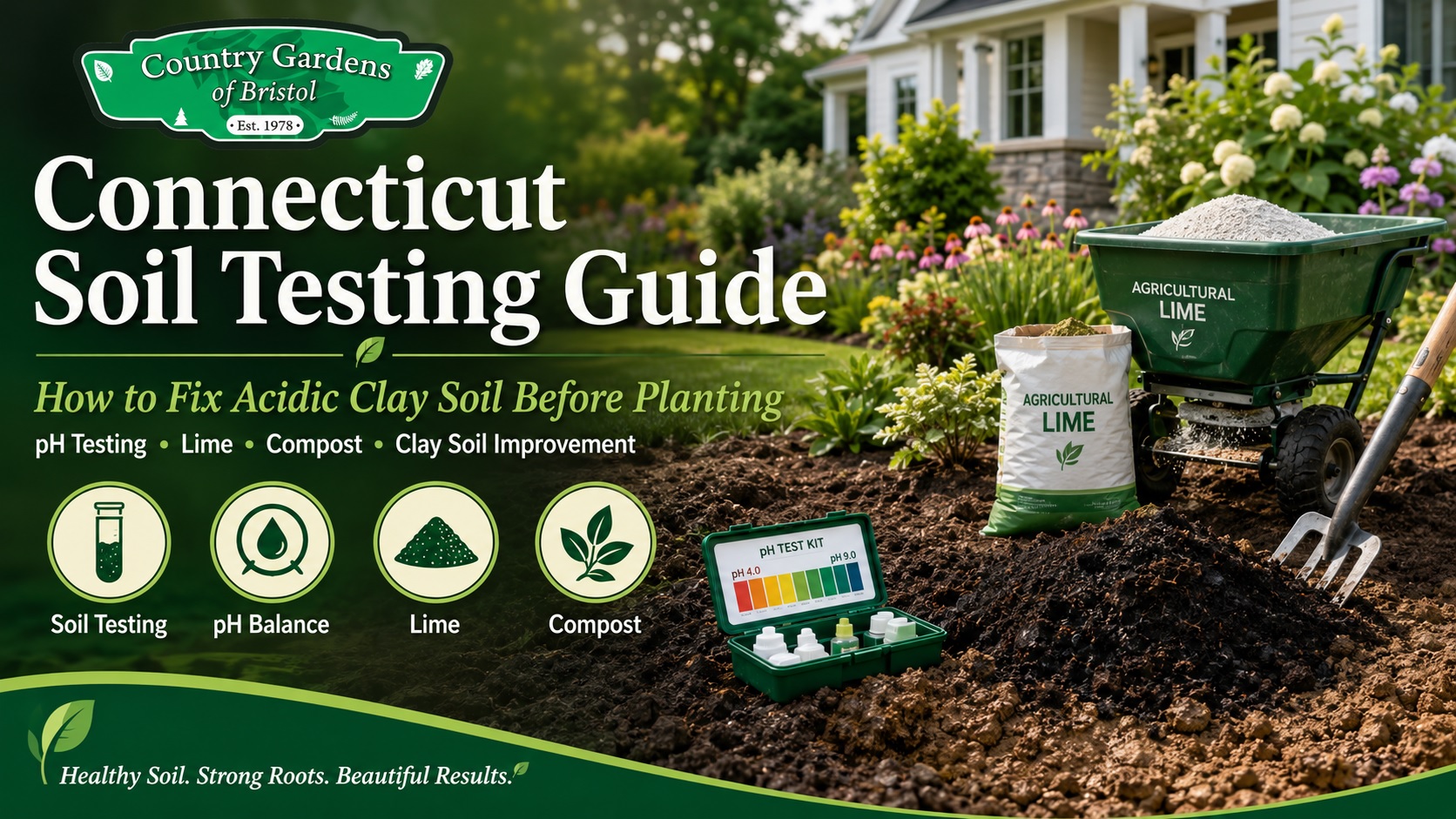
Successful Connecticut landscaping starts with testing the soil before adding lime, fertilizer, topsoil, or expensive plants. UConn Extension reports that most Connecticut soils are naturally acidic, while many residential properties also contain compacted clay-rich subsoil, disturbed construction fill, or poor drainage conditions. For lawns, UConn generally recommends a soil pH of about 6.0 to 7.0. When pH is too low, agricultural limestone can raise it, but the correct application rate should come from a soil test. Dense clay can be improved by loosening the root zone and incorporating quality compost or organic matter rather than simply covering the surface with new soil.
At Country Gardens of Bristol, we prefer to correct what is happening below the surface before installing a new lawn, perennial bed, shrubs, or specimen trees. Better soil preparation gives roots a stronger foundation from the first growing season.
Why Connecticut Soil Often Needs Preparation
Connecticut soil conditions vary considerably from one property to another.
UConn notes that naturally occurring soils across the state tend to be acidic. Some Connecticut soils can naturally fall around pH 4.5 to 5.5, while most turf, vegetables, and many ornamental plants perform better closer to slightly acidic or near-neutral conditions.
Around developed properties, we also commonly encounter:
- Compacted clay-rich subsoil
- Thin topsoil
- Construction fill
- Buried rocks and debris
- Poor drainage
- Hardpan
- Ledge close to the surface
- Soil compacted by construction equipment
These conditions can restrict oxygen, drainage, and root development even when the plants above look healthy at installation.
Step 1: Test the Soil Before Adding Anything
For homeowners searching soil testing CT, testing should come before buying bags of lime or fertilizer.
A standard soil test can identify:
- Current pH
- Phosphorus
- Potassium
- Calcium
- Magnesium
- Micronutrients
- Recommended limestone or sulfur
- Fertilizer recommendations
UConn recommends testing new planting areas and established landscapes that are performing poorly. Testing every three to five years is generally adequate for many home landscapes, with more frequent testing after major pH corrections.
Samples should represent the entire area rather than one convenient spot. Problem areas should be sampled separately.
What Is the Best Soil pH for CT Lawns?
For homeowners researching the best soil pH for CT lawns, a practical target is generally 6.0 to 7.0.
Within that range, major nutrients are readily available to turfgrass. When soil becomes strongly acidic, nutrients such as phosphorus, nitrogen, calcium, and magnesium may become less available even when fertilizer is present.
Not every plant wants that pH.
Blueberries, rhododendrons, and several other acid-loving plants prefer lower soil pH. That is another reason we avoid automatically spreading lime across every planting bed.
Step 2: Correct Acidic Soil With Agricultural Lime
When a test shows that soil pH is too low, limestone may be recommended.
Common products include ground limestone and pelletized limestone. Dolomitic limestone also supplies calcium and magnesium.
The amount needed depends on:
- Existing pH
- Target pH
- Clay content
- Organic matter
- Buffering capacity
Clay-rich soil generally resists pH changes more strongly than sandy soil, meaning two lawns with the same starting pH may require different lime rates.
UConn recommends following the laboratory’s application rate rather than estimating. Excessive lime can raise pH too far and create new nutrient-availability problems.
For detailed testing and lime recommendations, homeowners can use the UConn Soil Nutrient Analysis Laboratory.
Step 3: How to Fix Clay Soil in a Garden
The goal when learning how to fix clay soil in garden beds is not to eliminate clay. Clay can hold valuable moisture and nutrients.
The problem is usually compacted clay with too little pore space.
Roots need spaces within soil for oxygen and water movement. When heavy soil becomes tightly compacted, water may puddle at the surface while roots struggle to penetrate deeper.
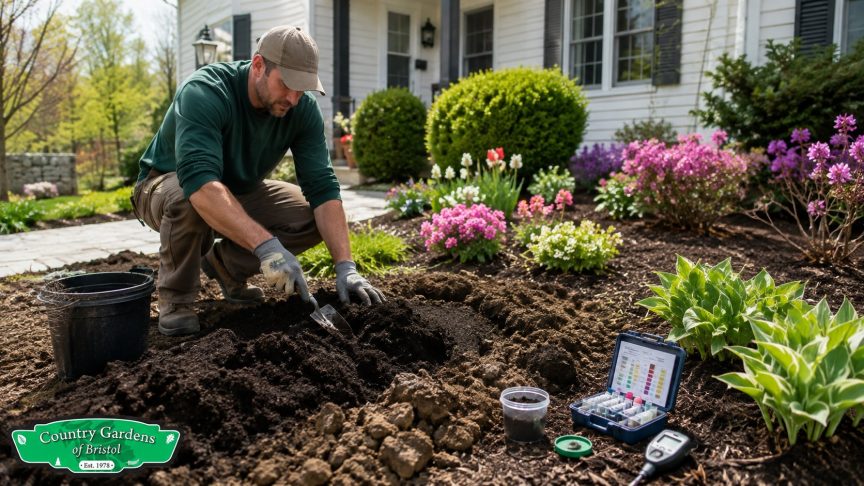
For new planting beds, our preparation may include:
- Removing rocks, roots, and construction debris.
- Mechanically loosening compacted soil.
- Correcting drainage or grading problems.
- Spreading quality compost or organic matter.
- Blending amendments into the existing root zone.
- Fine grading before planting.
Simply putting several inches of loose soil over hard clay can create a shallow growing layer sitting on top of an impermeable base.
Step 4: Add Compost to Improve Soil Structure
Organic matter is one of the most useful amendments for difficult soil.
Connecticut Agricultural Experiment Station guidance notes that incorporating compost into the upper soil profile can improve poorly drained soils while also increasing water and nutrient retention in coarse soils. For new lawns, compost can be incorporated into approximately the upper 4 to 6 inches where conditions require improvement.
Compost can help clay-rich soils develop:
- Better aggregation
- More pore space
- Improved drainage
- Better moisture management
- Easier root penetration
- Greater biological activity
More is not automatically better. Manure-heavy composts can contain substantial phosphorus, so amendment selection should still work with soil-test results.
Soil Preparation Matters Before Expensive Plantings
A newly installed tree or perennial may look perfect for several months while roots remain trapped inside the original planting hole.
That is why our landscape design and installation services account for soil conditioning, grading, drainage, plant selection, and long-term root development rather than focusing only on what the finished bed looks like.
This preparation becomes especially important with specimen trees, foundation plantings, privacy screens, and other larger landscape investments.
Do Not Ignore Drainage
Low pH and clay are not always the entire problem.
If water consistently pools after storms, adding compost or limestone alone will not correct the site. Grading, drainage improvements, or additional soil preparation may be required before planting.
Our related guide, Preparing Connecticut’s Compacted Clay and Ledge Rock for Hydroseeding Success, explains how compaction, soil depth, grading, and drainage affect root establishment in difficult Connecticut yards.
Build Better Soil Before Building the Landscape
Healthy landscaping begins underground.
At Country Gardens of Bristol, we can evaluate difficult soil, prepare planting areas, correct grading, incorporate soil amendments, condition beds, and create a stronger root zone before new lawns, shrubs, trees, or perennial gardens are installed.
Planning a new lawn or landscape installation? Contact Country Gardens of Bristol for site preparation, soil conditioning, grading, and planting-bed installation built around the actual conditions on the property.