
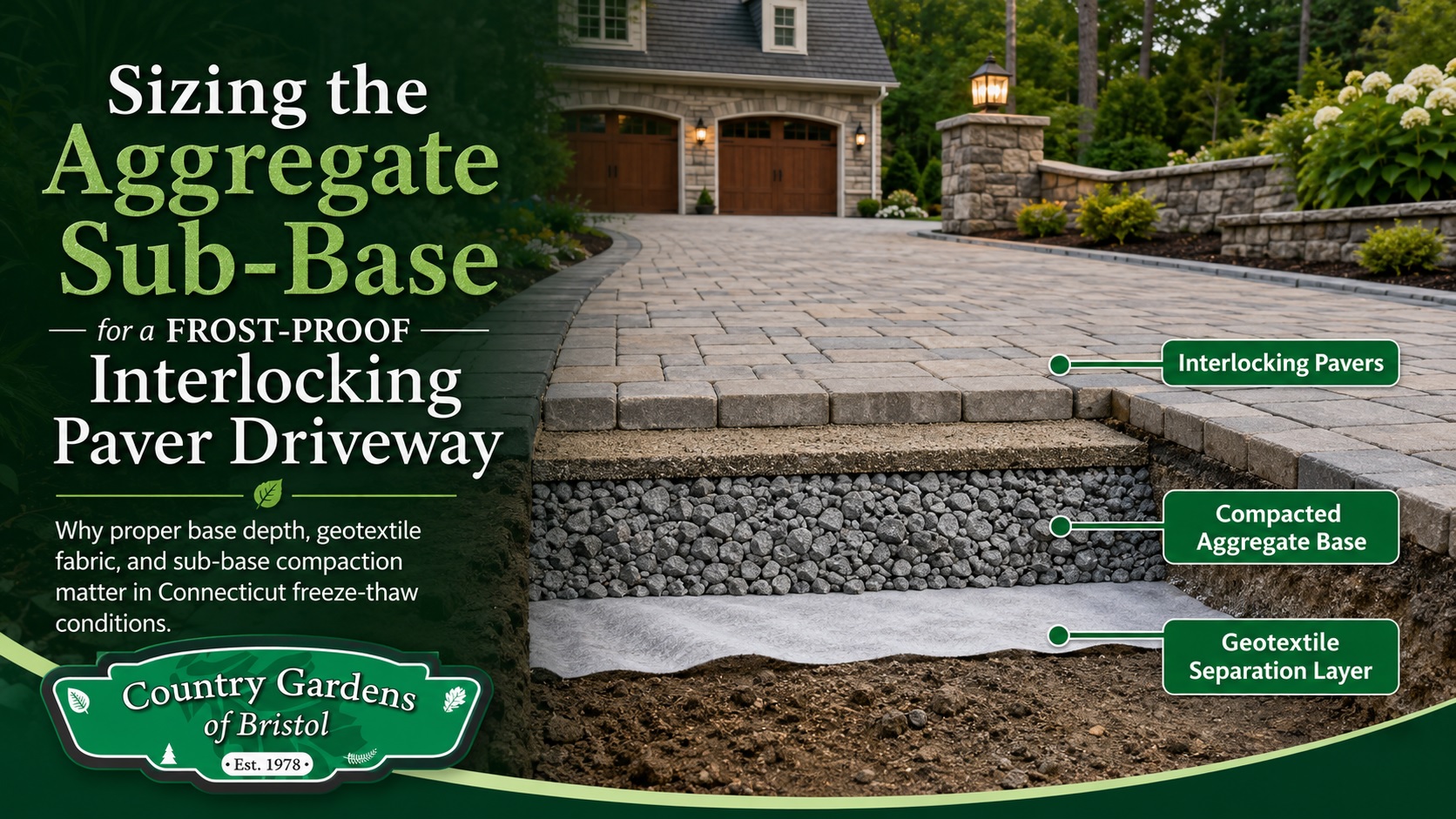
A frost-resistant interlocking paver driveway in Connecticut typically needs a compacted crushed stone aggregate base deeper than a basic walkway or patio. Many residential driveways start around 6 to 8 inches of compacted aggregate, but wet soil, clay, poor drainage, and heavy vehicles may require a thicker engineered base. Geotextile fabric helps separate native soil from the stone base, while proper sub base compaction in controlled lifts reduces settling, rutting, and frost heave.
Why Paver Driveways Fail in Connecticut
A paver driveway can look perfect on installation day and still fail after one or two Connecticut winters. The problem usually is not the paver itself. The problem is what sits under it.
Freeze-thaw cycles push water through soil, stone, joints, and weak sub-base layers. When trapped moisture freezes, it expands. When it thaws, the pavement settles into the empty space. That cycle can create raised edges, dips, tire ruts, joint separation, and uneven pavers.
At Country Gardens of Bristol, our hardscape work focuses on what homeowners do not always see: excavation depth, aggregate selection, geotextile separation, drainage, compaction, and finished grading.
The Correct Layer System for a Paver Driveway
A durable driveway is built in layers. Each layer has a job.
| Layer | Purpose |
|---|---|
| Compacted subgrade | Supports the entire driveway from below |
| Geotextile fabric | Separates soil from stone and helps reduce base contamination |
| Crushed stone aggregate | Carries vehicle loads and drains water |
| Bedding layer | Creates the final setting surface for pavers |
| Interlocking pavers | Forms the finished driving surface |
| Joint material | Locks units together and reduces movement |
| Edge restraint | Keeps pavers from spreading under vehicle pressure |
Cheap installations often fail because one of these layers is missing, too thin, or poorly compacted.
How Deep Should the Aggregate Sub-Base Be?
For a standard residential interlocking paver driveway, the compacted aggregate base often starts at 6 to 8 inches. In Connecticut, that number can increase when the driveway has clay soil, wet areas, poor drainage, steep slope, delivery truck traffic, or a long shaded section that stays frozen longer.
A practical planning guide:
| Driveway Condition | Suggested Compacted Aggregate Depth |
| Stable sandy soil, light vehicle use | 6 to 8 inches |
| Typical Connecticut residential driveway | 8 to 10 inches |
| Clay, wet soil, or poor drainage | 10 to 12 inches |
| Heavier vehicle use or weak subgrade | Engineer reviewed or deeper base |
This is why driveway replacement cost can vary so much. The visible paver may be only one part of the price. Excavation, stone depth, drainage correction, and compaction time often decide how long the driveway lasts.
Why Geotextile Fabric Matters
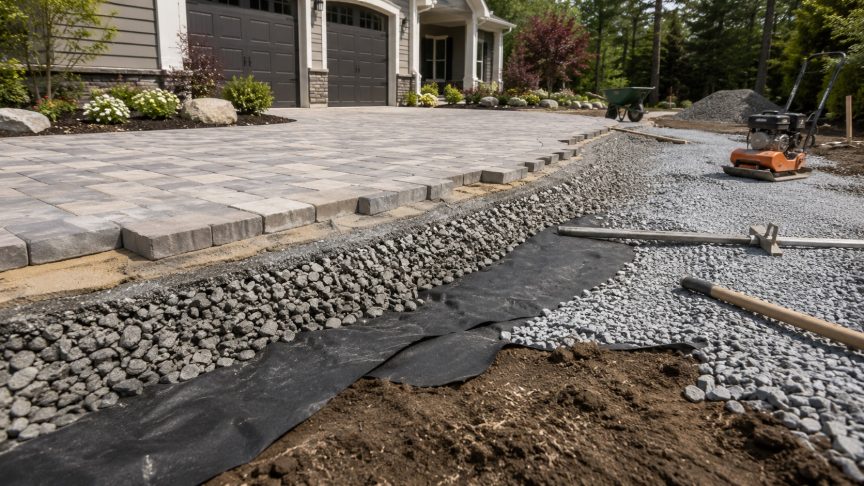
Geotextile fabric is not just an upsell. It acts as a separation layer between native soil and the crushed stone base. Without separation, fine soil particles can migrate upward into the stone. Over time, that reduces drainage and weakens the base.
On clay-heavy or wet Connecticut properties, geotextile fabric helps keep the aggregate layer cleaner and more stable. It also helps the driveway handle repeated freeze-thaw movement more consistently.
Our landscape design process considers grade, soil, drainage, and circulation before recommending the final driveway structure.
Sub Base Compaction: The Step That Cannot Be Rushed
Sub base compaction should happen in lifts, not in one thick dump of stone. If 10 inches of base is needed, the aggregate should be installed and compacted in smaller layers. This allows the compactor to lock the stone together instead of only tightening the surface.
A proper sequence looks like this:
- Excavate to the designed depth.
- Remove soft, organic, or unstable soil.
- Compact the native subgrade.
- Install geotextile fabric where needed.
- Place crushed stone in controlled lifts.
- Compact each lift before adding the next layer.
- Check slope and drainage.
- Add bedding material.
- Install pavers, edge restraints, and joint material.
This is the difference between a decorative driveway and an engineered driveway.
Drainage Decides Long-Term Performance
Water should move away from the driveway surface and away from the base. If water sits under the pavers, frost heave becomes more likely.
For some properties, drainage planning may include grading correction, stone drains, swales, downspout adjustments, or nearby irrigation modifications. For newly disturbed areas around the driveway, hydroseeding can help stabilize soil and reduce erosion after construction.
Why Professional Paver Driveway Installers Cost More Upfront
Homeowners searching for paver driveway installers or hardscape contractors near me often compare square foot prices. That can be misleading. A low quote may include a thinner base, no fabric, poor excavation, weak edge restraints, or rushed compaction.
Professional installation costs more because the hidden structure is built for Connecticut conditions. At Country Gardens of Bristol, our team installs interlocking pavers CT homeowners can trust because the base is designed before the first paver is set.
Work With Country Gardens of Bristol
A frost-proof paver driveway starts below the surface. The right crushed stone depth, geotextile fabric, drainage plan, and compaction process help prevent settling, heaving, and premature replacement.
Country Gardens of Bristol designs and installs hardscapes for homeowners in Bristol, Southington, Plainville, Farmington, Burlington, Harwinton, Plymouth, Wolcott, and surrounding Connecticut communities. Contact our team to plan a paver driveway built for real New England weather.