
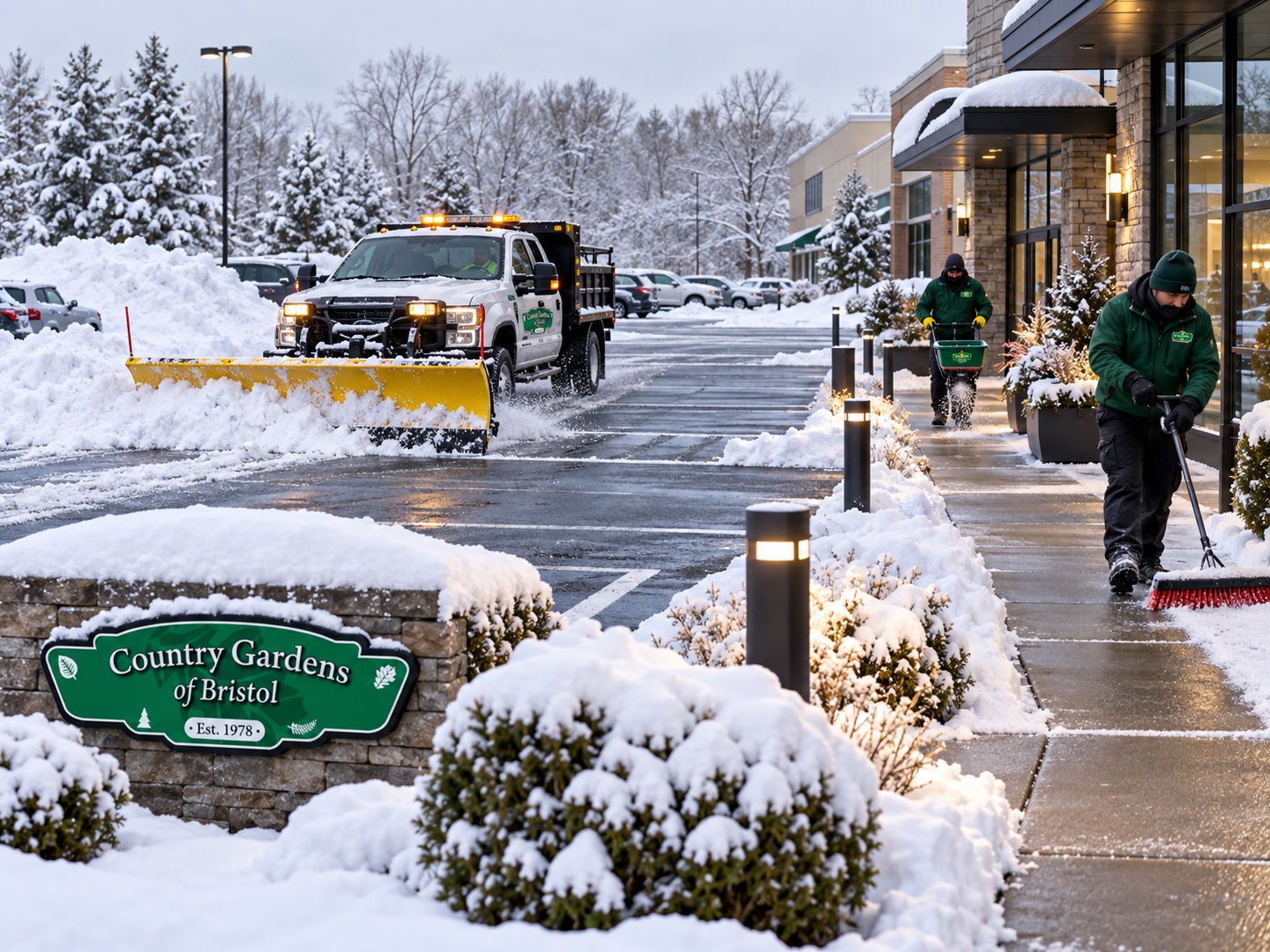
Commercial snow plowing primarily moves accumulated snow from parking lots, drive lanes, and other paved surfaces into designated stacking areas. Commercial snow removal is a broader winter-management service that can include plowing, sidewalks, entrances, de-icing, anti-icing, snow stacking, hauling, refreeze checks, and storm response. For Connecticut businesses, the right service scope depends on property size, operating hours, traffic, snow-storage space, and safety priorities.
When a Connecticut business requests a snow quote, the terms snow plowing and snow removal are often used interchangeably. In practice, they can describe very different levels of service.
At Country Gardens of Bristol, we look beyond simply getting a plow truck onto the property. Commercial sites may need parking lots open before employees arrive, sidewalks cleared for customers, entrances treated for ice, and snow piles managed so valuable parking spaces stay usable.
Understanding the difference helps property managers compare contracts based on scope rather than price alone.
What Is Commercial Snow Plowing?
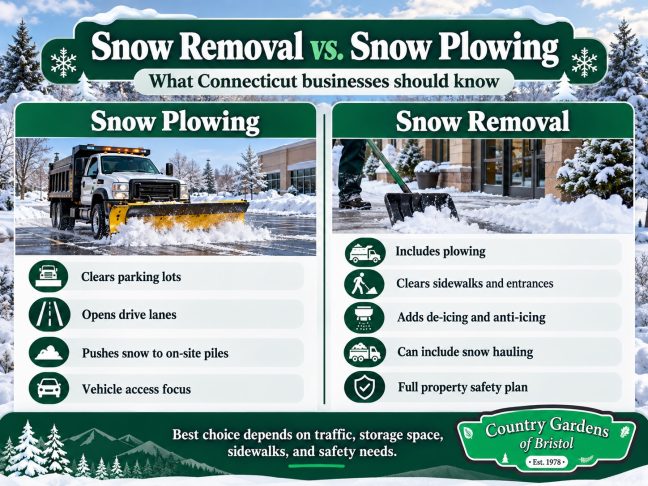
Commercial snow plowing is primarily the mechanical movement of accumulated snow from paved areas.
Typical plowing areas include:
- Parking lots
- Drive lanes
- Loading areas
- Service roads
- Dumpster access
- Fire lanes
- Main vehicle entrances
Plow trucks, loaders, skid steers, and snow pushers move snow toward predetermined stacking areas.
The goal is to restore vehicle access efficiently while keeping traffic patterns, parking capacity, hydrants, entrances, and visibility in mind.
Country Gardens uses commercial-grade equipment for parking lot clearing and plans designated snow-stacking areas before winter service begins.
What Is Commercial Snow Removal?
Commercial snow removal usually describes the complete process of managing snow and ice across a property, not only pushing snow across a parking lot.
A full program may include:
- Parking lot plowing
- Sidewalk clearing
- Building entrance clearing
- Loading-dock service
- De-icing
- Liquid anti-icing
- Snow stacking
- Snow hauling
- Refreeze checks
- Storm monitoring
- Emergency response
This broader scope is especially important for retail centers, office properties, industrial facilities, medical sites, HOAs, and other properties where both vehicle and pedestrian access matter.
Our commercial snow removal services combine parking lot clearing with sidewalks, entrances, ice management, storm monitoring, and additional winter services based on property needs.
Snow Removal vs. Snow Plowing: What’s the Difference?
| Service | Snow Plowing | Commercial Snow Removal |
|---|---|---|
| Parking lots | Yes | Yes |
| Drive lanes | Yes | Yes |
| Snow stacking | Usually | Yes |
| Sidewalk clearing | Not necessarily | Often included |
| Entrance clearing | Not necessarily | Often included |
| De-icing | Separate or additional | Can be included |
| Anti-icing | Usually separate | Can be included |
| Snow hauling | No | Available when required |
| Refreeze monitoring | Usually separate | Can be part of service |
| Full property planning | Limited | Broader winter-management approach |
The exact terminology can vary between contractors. What matters most is what the written snow contract actually includes.
Does Snow Removal Mean the Snow Leaves the Property?
Not always.
This is one of the biggest sources of confusion.
During normal snow service, snow may be plowed and stacked on the property in predetermined areas. That still may be described as part of a commercial snow removal program.
Actual snow hauling means loaders place accumulated snow into trucks so it can be transported away from the site.
Hauling becomes useful when snow piles begin consuming parking spaces, obstructing sightlines, limiting traffic flow, or leaving too little space for the next storm.
Country Gardens identifies stacking locations during pre-season planning and can arrange snow hauling when on-site storage becomes limited.
Why Plowing Alone May Not Be Enough for a Commercial Property
Clearing the main parking area solves only one part of winter access.
Consider a retail property where the lot has been plowed but:
- The sidewalk remains covered
- The entrance has packed snow
- Meltwater has refrozen overnight
- Accessible routes are blocked
- Snow piles reduce visibility
- Loading docks cannot be reached safely
The parking lot may technically be plowed, yet the property is not fully ready for normal operations.
That is why commercial snow management often involves separate crews, equipment, and treatments for pedestrian and vehicle areas.
Where Does De-Icing Fit?
De-icing is different from plowing.
A plow removes accumulated snow. De-icing products help manage frozen precipitation and slippery surfaces that remain before or after plowing.
Country Gardens’ commercial winter program includes salt spreading and liquid anti-icing applications as part of broader snow and ice management. The team also performs post-storm checks where refreezing may create new hazards.
For Connecticut properties, this matters because daytime melting can turn into overnight ice as temperatures fall.
What Is Pre-Storm Anti-Icing?
Anti-icing happens before qualifying winter precipitation begins.
Liquid treatments can be applied to pavement to help reduce the bond between frozen precipitation and the surface. That can make subsequent clearing more effective.
It does not replace plowing during an accumulating storm. Instead, it becomes another part of the overall snow-management plan.
Which Service Does a Commercial Property Need?
The answer depends on how the property operates.
Basic Plowing May Work for:
- Lower-traffic properties
- Sites with limited pedestrian areas
- Properties with generous snow-storage space
- Locations where other crews handle sidewalks and ice
Broader Snow Removal Makes More Sense for:
- Retail centers
- Medical facilities
- Office complexes
- HOAs
- Industrial properties
- High-traffic lots
- Early-opening businesses
- Sites with extensive sidewalks
- Properties with limited snow-storage space
A business opening at 6:00 AM also requires a different service plan than a building that remains closed until later in the morning.
Why the Contract Matters More Than the Service Name
Two proposals labeled commercial snow removal may contain completely different scopes.
Before comparing prices, check whether the contract defines:
- Trigger depth
- Parking lot service
- Sidewalks
- Entrances
- Salt applications
- Liquid anti-icing
- Return visits
- Refreeze response
- Snow stacking
- Snow hauling
- Emergency service
- Service timing
Our related guide to commercial snow removal contracts in Connecticut explains how per-push and seasonal agreements handle these services differently.
Plan for the Whole Property, Not Just the Parking Lot
Commercial snow plowing is an important part of winter property management, but it is only one component.
A complete snow removal plan considers how vehicles enter, where customers walk, when employees arrive, where snow can be stored, how ice will be treated, and what happens when piles become too large for the site.
At Country Gardens of Bristol, we provide commercial snow removal and ice management for businesses throughout Bristol and surrounding Connecticut communities, with parking lot clearing, sidewalks, entrances, de-icing, emergency response, and custom service plans.
Plan the service scope before the first major Connecticut storm so the property has a clear strategy for snow, ice, access, and storage.
Frequently Asked Questions
Is snow plowing the same as snow removal?
Not exactly. Plowing primarily moves snow from paved vehicle areas, while snow removal can describe broader property management including plowing, sidewalks, ice control, stacking, and hauling.
What does commercial snow removal include?
Services may include parking lot plowing, sidewalk and entrance clearing, de-icing, anti-icing, storm monitoring, refreeze checks, snow stacking, and hauling.
When does snow need to be hauled away?
Hauling may be needed when on-site piles reduce parking capacity, block sightlines, interfere with access, or leave insufficient storage space for additional storms.
Does commercial snow removal include salting?
It can, but the contract should say so specifically. Salt and liquid treatments may be bundled into a program or priced separately.
Is snow plowing cheaper than full snow removal?
Plowing can have a narrower scope, but final cost depends on property size, snowfall, equipment, sidewalks, ice treatments, service frequency, hauling, and contract structure.