
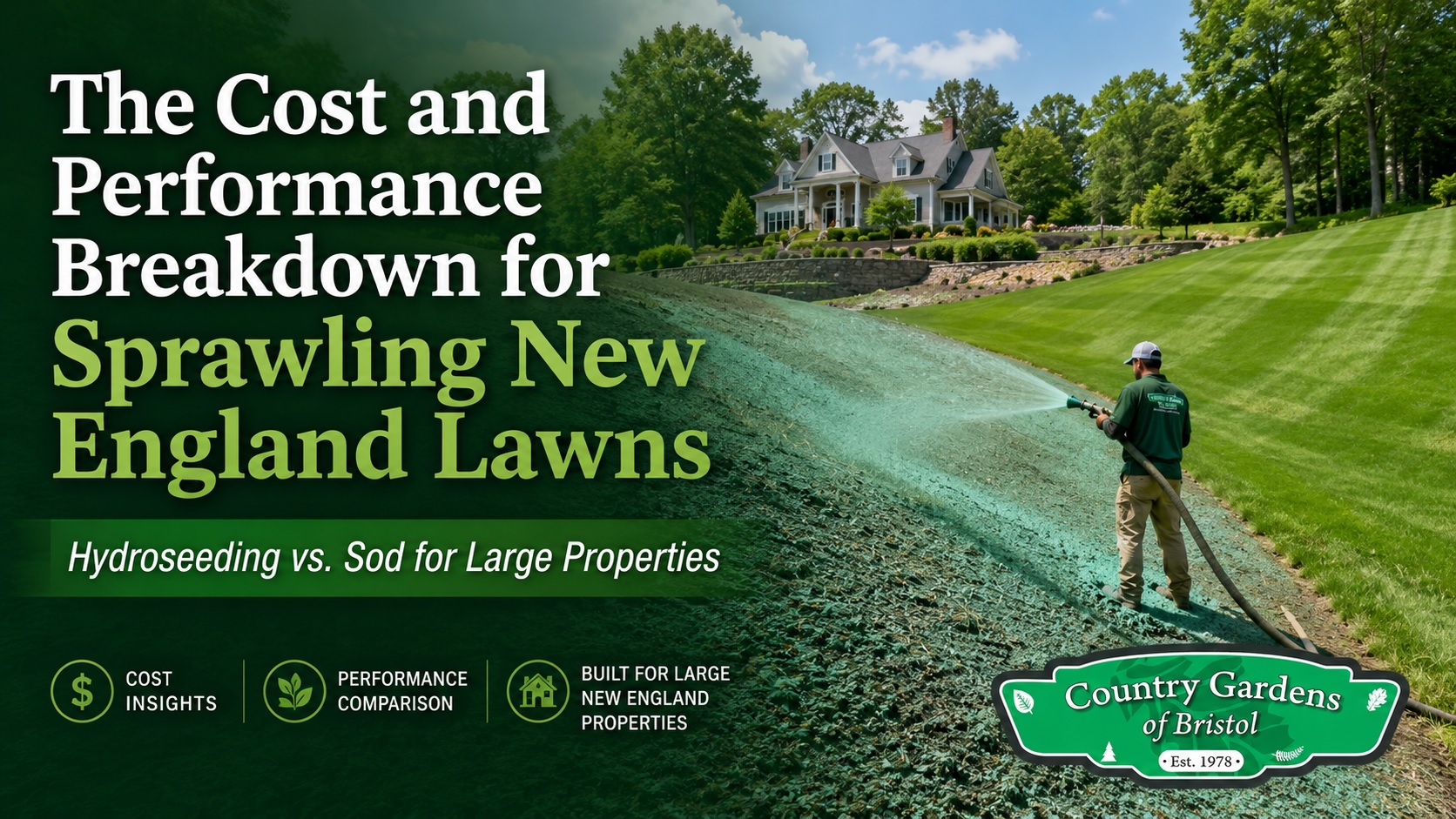
For homeowners, estate managers, builders, HOAs, and commercial property owners across Bristol, Farmington, Southington, Plainville, Burlington, Avon, Wolcott, Harwinton, Plymouth, and Central Connecticut, large lawn installation comes down to two questions: what will establish successfully on local soil, and what will make sense financially at scale? At Country Gardens of Bristol, our team often recommends hydroseeding when wide lawn areas, hillsides, construction-disturbed soil, and acreage make traditional sod expensive or difficult to place.
Why Hydroseeding Fits Large Connecticut Lawns
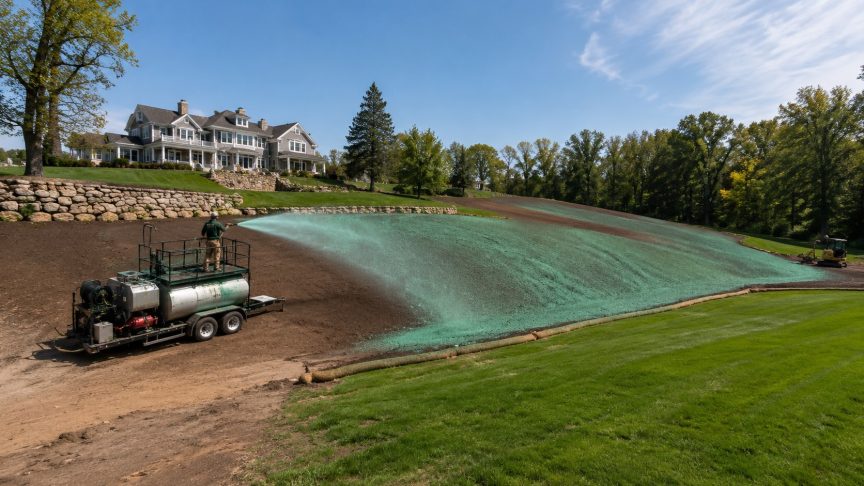
Hydroseeding is a mechanical lawn establishment process where seed, water, mulch fiber, fertilizer, and tackifiers are blended into a slurry and sprayed evenly over prepared soil. Once applied, the slurry forms a moisture-locking bond that helps seed stay in contact with the ground.
That matters for New England properties because many yards include slopes, compacted clay, ledge rock, drainage cuts, construction fill, and uneven acreage. Rolling sod over those conditions can be costly, labor heavy, and limited by access. Hydroseeding can cover larger areas faster while still allowing the seed blend to be matched to site conditions.
Learn more about our hydroseeding services for new lawns, patchy yards, slopes, and erosion-prone areas.
Hydroseeding vs. Sod: Cost at Scale
The cost of sod installation per square foot is usually higher because sod must be grown, cut, transported, delivered, placed by hand or equipment, rolled, watered, and rooted into the soil. Sod provides an immediate green surface, but the price can climb quickly on large Connecticut properties.
Hydroseeding is usually more affordable per square foot, especially for acreage, hillsides, commercial lawns, and lawn restoration services after construction.
| Lawn Method | Typical Best Fit | Cost Behavior |
|---|---|---|
| Hand seeding | Small low-budget repairs | Lowest material cost, slower and more exposed |
| Hydroseeding | Large lawns, slopes, new builds, acreage | Strong value for broad coverage |
| Sod | Small premium areas needing instant green | Higher cost due to material and labor |
| Artificial turf | Specialty zones and low-maintenance spaces | Higher upfront cost, no natural growth |
For sprawling lawns, the price gap becomes more important. A small front yard may justify sod. A multi-acre lawn, roadside slope, commercial green space, or long backyard grade often points toward hydroseeding.
How the Slurry Improves Growth Mechanics
Hydroseeding works because the slurry does several jobs at once.
The seed begins the lawn.
The mulch fiber helps hold moisture.
The tackifier helps the material bond to the soil.
The fertilizer supports early establishment.
The water activates the mix and carries it evenly across the surface.
This is why hydroseeding services near me should not be judged only by spray equipment. The seedbed, slope, soil quality, moisture plan, and mix design all influence the final result.
Our blog about explains how Preparing Connecticut’s Compacted Clay and Ledge Rock for Hydroseeding Success, where soil preparation is treated as the foundation of a successful lawn.
Why Soil Prep Still Decides the Outcome
Hydroseeding is not magic paint for poor soil. If seed is sprayed over compacted clay, exposed rocks, construction debris, or hardpan, roots may struggle to establish.
A strong lawn restoration plan may include:
- Clearing rocks, weeds, debris, and failed turf
- Rough grading for drainage and shape
- Adding screened topsoil or compost blends when needed
- Fine grading for a smooth seedbed
- Applying hydroseed slurry evenly
- Watering consistently during establishment
- Mowing only after young turf reaches the right height
Our landscape design and irrigation services can also support larger lawn projects where grading, water control, and long-term maintenance all need to work together.
When Commercial Hydroseeding Contractors Make Sense
Commercial hydroseeding contractors are valuable when the project involves acreage, slopes, subdivision lots, municipal areas, business campuses, roadside edges, or construction-restored lawns.
Hydroseeding is often preferred for:
- Large residential lawns
- New construction lawn installation
- Hillsides and slopes
- Commercial properties
- HOA common areas
- Roadside or utility restoration
- Erosion-prone areas
- Patchy lawn rehabilitation
- Sports and recreation fields
Build the Lawn From the Soil Up
For large New England lawns, the best value is not always instant sod. Hydroseeding gives property owners a practical balance of cost, coverage, seed customization, slope performance, and moisture retention when the soil is prepared correctly.
Country Gardens of Bristol helps homeowners, builders, and commercial property owners plan lawn restoration services around Connecticut soil, drainage, slope, and long-term maintenance needs.
FAQ
Is hydroseeding cheaper than sod?
Hydroseeding is usually more cost-effective than sod for large lawns because it uses a sprayed slurry rather than pre-grown turf rolls that require transport and labor-heavy installation.
How long does hydroseeding take to grow?
Growth depends on seed type, soil temperature, watering, weather, and site prep. Many lawns begin showing green growth within the early establishment window, but full thickening takes continued care.
Is hydroseeding good for slopes?
Yes. Hydroseeding is useful for slopes because the mulch and tackifier help bind seed to the soil surface while supporting moisture retention.
Who offers hydroseeding services near me in Bristol CT?
Country Gardens of Bristol provides hydroseeding services for Bristol and nearby Connecticut towns, including Farmington, Southington, Plainville, Burlington, Avon, Wolcott, Harwinton, and Plymouth.