
How Long Does Hydroseed Take to Grow in Connecticut? Germination Timeline & Care Guide
Quick Answer
How long does hydroseed take to grow? Under favorable conditions, a newly hydroseeded lawn can begin showing a light green haze in about 5 to 7 days, while a fuller, mowable lawn often develops within 3 to 4 weeks. The exact hydroseed germination time depends on the grass seed blend, soil temperature, moisture, sunlight, soil preparation, and weather. At Country Gardens of Bristol, we stress consistent watering during the first two weeks because allowing the slurry to dry out can slow or reduce germination. Our hydroseeding services in Bristol, CT include seed blends selected for Connecticut growing conditions.
A new hydroseed lawn does not become mature the moment green shoots appear. Germination is only the first stage. Root development, thickening, mowing, and establishment continue for weeks afterward.
What Does a Normal Hydroseed Timeline Look Like?
Homeowners often expect hydroseed to turn into a finished lawn almost immediately. The process happens in stages.
Days 1 to 4: Keep the Slurry Moist
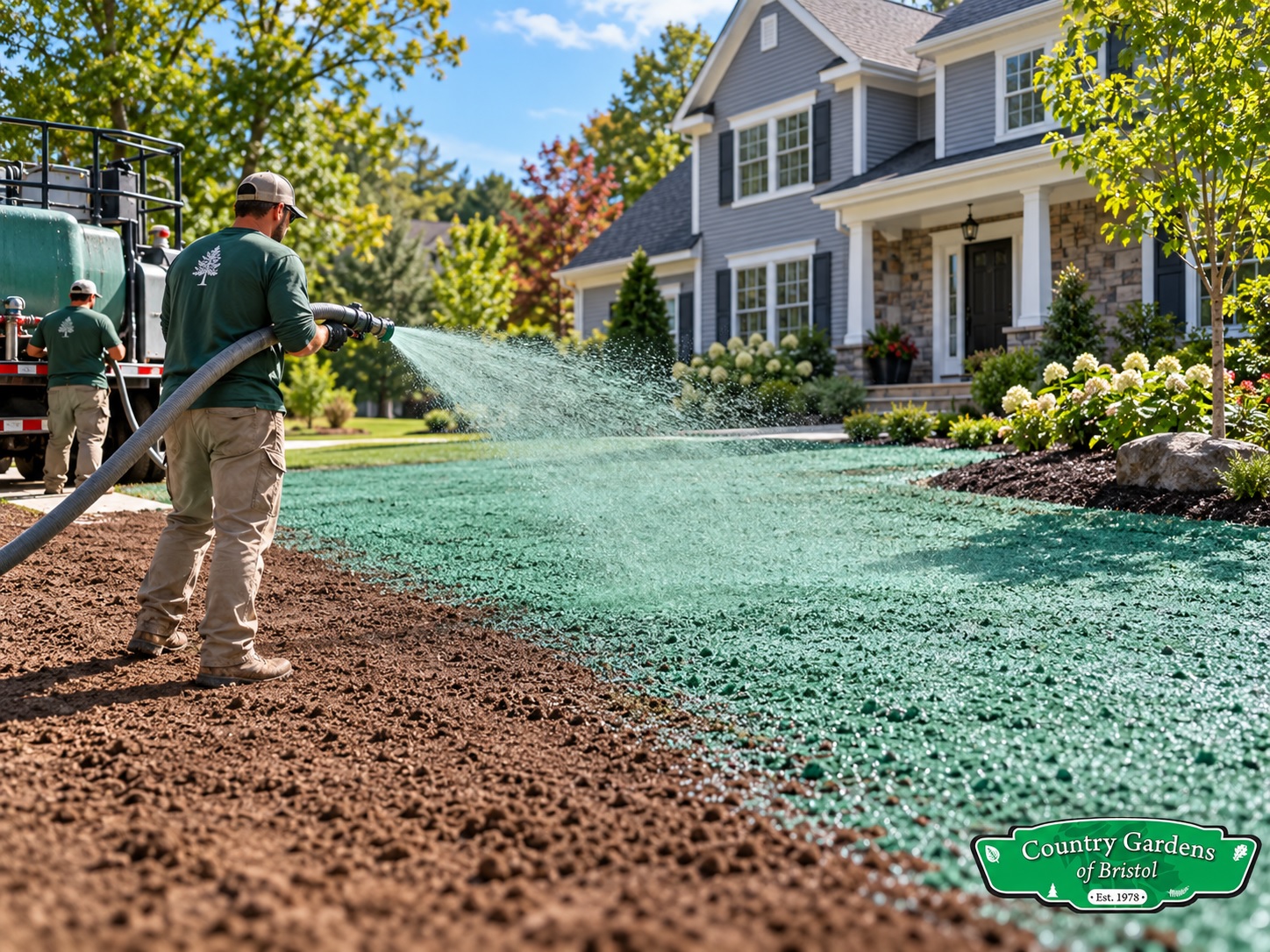
Right after application, the mulch, seed, fertilizer, and other components form a protective layer over the prepared soil.
During this stage, our main goal is moisture.
The surface should stay consistently damp without becoming flooded. Heavy watering can move seed, create washouts, or cause puddling. Letting the slurry completely dry can delay germination.
Days 5 to 10: The First Green Growth
Under favorable conditions, some of the faster-germinating grasses may begin appearing during the first week.
Country Gardens notes that Connecticut hydroseed projects can often show a green haze in 5 to 7 days when temperature, watering, and soil conditions cooperate.
Oregon State University Extension similarly reports that green grass is commonly visible about 7 to 10 days after seeding, while noting that perennial ryegrass germinates faster than species such as Kentucky bluegrass.
Do not worry if every part of the lawn does not turn green at exactly the same time.
Why Does Some Hydroseed Grow Faster Than the Rest?
Most hydroseed applications use a mixture rather than a single grass species.
Different seeds have different germination schedules. Perennial ryegrass is one of the fastest cool-season turf grasses, with germination commonly occurring in roughly 5 to 7 days under favorable conditions. Kentucky bluegrass can require 21 days or longer.
That means a lawn may look thin at first even though slower grasses are still developing.
Sun exposure can also create differences. Warm, sunny areas may germinate sooner, while shaded or cooler sections may take longer.
Weeks 2 to 3: The Lawn Starts Filling In
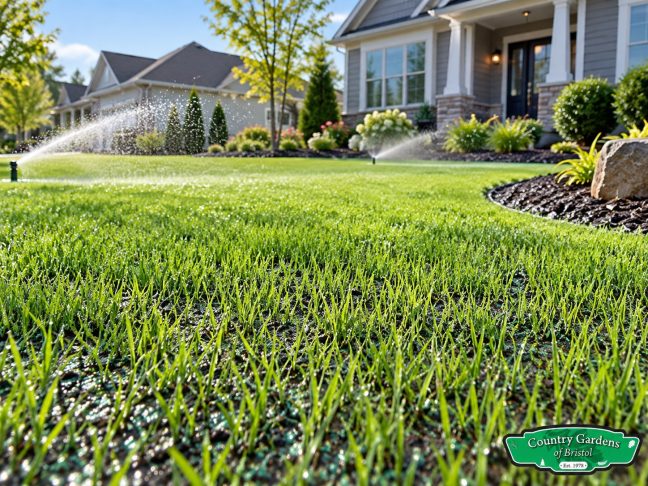
During the second and third weeks, more seedlings should emerge and the lawn should gradually look less patchy.
We still recommend treating the grass gently.
Avoid:
- Heavy foot traffic
- Pets running across seedlings
- Moving equipment over the lawn
- Letting the seedbed dry out
- Heavy watering that creates runoff
The roots are still shallow during this stage.
A lawn that receives proper soil preparation generally establishes more reliably than seed applied over compacted construction soil or rocky fill. Our guide to preparing Connecticut soil for hydroseeding explains why grading, loosening compacted soil, and improving the seedbed matter before application.
Weeks 3 to 4: First Mowing May Be Close
Under good growing conditions, many hydroseeded lawns become mowable within roughly 3 to 4 weeks.
We do not recommend mowing simply because some grass looks tall.
Wait until enough of the lawn has reached an appropriate mowing height and the soil is firm enough that mower tires will not create ruts or pull young seedlings from the ground.
Use a sharp mower blade and avoid removing too much grass at once.
How Often Should New Hydroseed Be Watered?
Watering is one of the biggest factors affecting hydroseed germination time.
For approximately the first two weeks, our goal is to keep the mulch consistently moist. Country Gardens generally recommends short watering sessions about two to three times daily during early establishment, adjusted for weather, soil, shade, and rainfall.
A hot, sunny slope can dry much faster than a shaded level lawn.
Once seedlings become established and approach roughly two inches tall, watering can gradually transition toward deeper, less frequent applications.
What Can Slow Hydroseed Germination?
Several conditions can make a new hydroseed lawn take longer than expected:
- Cold soil
- Excessive heat
- Inconsistent watering
- Heavy rain and erosion
- Compacted soil
- Poor seed-to-soil contact
- Thin or low-quality topsoil
- Too much shade
- Poor drainage
- Wrong seed selection
Soil preparation deserves special attention. Hydroseeding cannot compensate for severely compacted clay, exposed ledge, or poorly graded construction fill.
When Should We Worry About Bare Areas?
Some uneven growth during the first couple of weeks is normal.
We become more concerned when large areas remain completely bare after the expected germination period, especially when neighboring sections are developing well.
Before adding more seed, we look for the reason. Washout, dry soil, compaction, standing water, shade, or poor seed-to-soil contact may be responsible.
Correcting the cause gives reseeding a better chance of succeeding.
When Will a Hydroseeded Lawn Look Finished?
Visible germination can happen within a week, but a mature lawn takes much longer.
Think of the process this way:
5 to 10 days: Early green growth may appear
2 to 3 weeks: Coverage becomes more noticeable
3 to 4 weeks: First mowing may be possible
Following weeks and months: Roots deepen and turf continues thickening
At Country Gardens of Bristol, we remind homeowners that hydroseeding starts the lawn quickly, but watering, soil conditions, mowing, and continued care determine how well that lawn develops.
A strong lawn is built through establishment, not just germination.