

Connecticut sprinkler systems should generally be shut down and winterized during October through early November, before repeated overnight freezes can trap ice inside valves, backflow preventers, sprinkler heads, and underground lines. Turning off the irrigation water alone does not guarantee that every low point drains. A proper blowout uses enough compressor airflow to move trapped water through each zone while keeping air pressure within the pipe manufacturer’s limits. Hunter recommends keeping blowout pressure below 50 PSI for polyethylene pipe and below 80 PSI for PVC systems.
At Country Gardens of Bristol, we recommend reserving fall irrigation winterization before freezing weather becomes an immediate concern. Waiting until a hard November freeze can leave vulnerable components full of water at exactly the wrong time.
When to Shut Off Sprinklers in Fall
For homeowners asking when to shut off sprinklers in fall, the goal is balancing late-season lawn watering with freeze protection.
Across Central Connecticut, a practical service window normally runs from early October through early November. Our existing Connecticut irrigation winterization guidance recommends completing the process before sustained freezing conditions arrive.
Do not use the first fallen leaf as the deadline. Watch overnight temperatures instead.
A lawn may still need occasional water during a dry October, but an irrigation system becomes a liability once exposed plumbing and trapped underground water begin experiencing repeated freezing temperatures.
Why Simply Turning Off the Water Is Not Enough
An underground irrigation system rarely drains perfectly by gravity.
Water can remain inside:
- Zone valves
- Low sections of lateral pipe
- Manifolds
- Sprinkler bodies
- Swing joints
- Backflow assemblies
- Mainline sections
When trapped water freezes, expansion can stress fittings, valve bodies, pipe walls, and seals.
The damage may remain hidden until spring startup, when cracked components begin leaking under pressure.
That is why our irrigation services in Bristol, CT include seasonal winterization along with installation, repairs, system adjustments, and startup service.
Backflow Preventers Need Special Attention
The backflow preventer is often one of the most vulnerable parts of an irrigation system because many assemblies are mounted above ground.
Shutting the main irrigation valve does not automatically empty every chamber inside the backflow device.
Hunter recommends shutting off the irrigation water supply and properly draining or winterizing exposed system components as part of the blowout process. Rain Bird also advises protecting exposed backflow preventers and valves while keeping vents and drainage openings unobstructed.
A cracked backflow body can turn an overlooked fall maintenance task into a much more expensive spring repair.
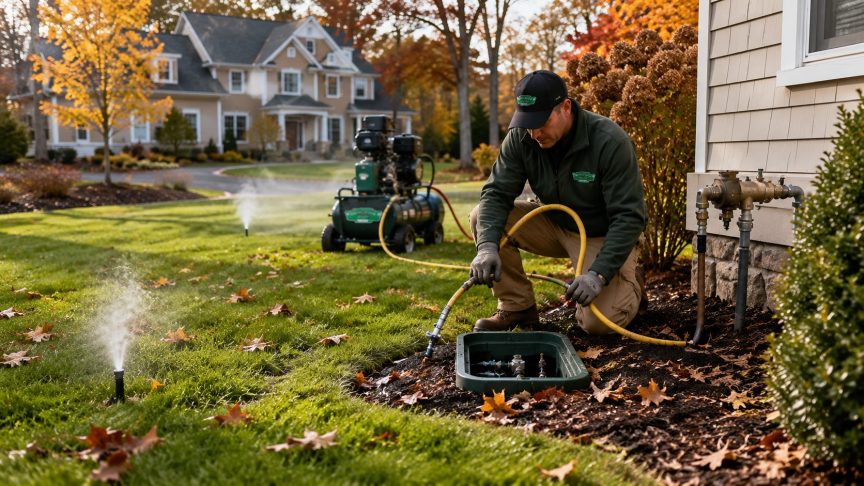
How to Blow Out an Irrigation System With a Compressor
A professional blowout uses airflow and controlled pressure together.
The general process is:
- Shut off the irrigation water supply.
- Relieve water pressure from the system.
- Connect the compressor at the proper blowout connection.
- Open or activate a sprinkler zone.
- Introduce regulated compressed air gradually.
- Allow water to discharge through the sprinkler heads.
- Move through each zone until standing water has been cleared.
- Properly drain and protect the backflow assembly and exposed plumbing.
The compressor should never simply be connected at maximum pressure.
Hunter states that pressure should remain below 50 PSI for polyethylene pipe and 80 PSI for PVC during blowout.
CFM Matters as Much as PSI
One of the biggest DIY mistakes is focusing only on compressor PSI.
Pressure pushes against the system. CFM, or cubic feet per minute, determines how much air volume moves through it.
A small shop compressor may reach high PSI yet lack enough sustained airflow to move water through long underground zones effectively.
Hunter provides a useful airflow calculation based on the largest irrigation zone:
Largest Zone GPM ÷ 7.5 = Approximate Required CFM
For example, a 30-GPM zone would require roughly 4 CFM at the connection under that sizing method. Actual system requirements depend on layout, pipe diameter, zone size, and equipment.
More pressure is not the solution to inadequate airflow. Excess pressure can damage fittings, heads, seals, and pipe.
PVC, Polyethylene, and Other Underground Lines
Connecticut irrigation systems can contain PVC, polyethylene, flexible tubing, or other approved piping materials depending on age and installation design.
PVC is rigid and vulnerable to damage when trapped water freezes inside a confined section.
Polyethylene offers more flexibility, but valves, fittings, manifolds, and sprinkler components can still crack when water freezes.
That means the safest strategy is removing as much trapped water as practical rather than assuming flexible pipe makes winterization unnecessary.
What Affects Sprinkler Blowout Cost?
Sprinkler blowout cost varies according to the system rather than one universal price.
Factors commonly include:
- Number of irrigation zones
- Property size
- Compressor access
- Backflow configuration
- System complexity
- Multiple controllers or water sources
- Repairs needed before winterization
A six-zone residential system is very different from a large commercial property with extensive mainlines and multiple valve banks.
Scheduling early can also make fall service easier than waiting until the first freeze warning creates a rush of last-minute appointments.
Do Not Overlook the Controller
Winterization also includes preparing the controller correctly.
We generally want irrigation programs disabled without unnecessarily erasing programming that will be useful during spring startup.
Some smart controllers also contain seasonal settings or shutdown modes that can simplify the transition.
Our related Connecticut Irrigation Winterization Guide covers the complete seasonal process, including professional compressor blowouts and spring startup checks.
Protect the System Before November Freezes
A sprinkler system can look completely inactive while several gallons of water remain trapped underground.
That hidden water is why fall winterization matters.
We shut off the supply, drain exposed components, use regulated compressed air to clear each zone, and protect vulnerable backflow and valve assemblies before Connecticut freezing weather arrives.
Reserve your fall irrigation blowout and winterization slot with Country Gardens of Bristol before the seasonal schedule fills.